The French Are Going to Surrender Again
When marking the centenary of the terrible events of 1917, some of the near devastating of World State of war I, it is peradventure understandable that the British have focused their attention on the Passchendaele offensive and the Americans on their entry into the war confronting Frg. Unfortunately, their desire to commemorate the heroism of their own service personnel often has an ugly flip-side: the denigration of the courage and skill of their French allies.
This mental attitude is best captured in the phrase "cheese-eating surrender monkeys", coined in a 1995 episode of The Simpsons and popularised by journalist Jonah Goldberg in a 1999 column for The National Review. Information technology suggested, among other things, that the French "surrendered Paris to the Germans [in 1940] without firing a shot".
Doubtless the piece was satirical in intent, but the seriousness of the underlying prejudice became all also obvious in 2003; witness the invective directed at the French by US and British politicians and media following France'southward (retrospectively, wise) decision not to support military intervention in Republic of iraq.
If the British and Americans are serious about remembrance, then let's call back France's war machine performance fairly.
Exist fair on the French
From August 1914 to early 1917, it was the French Army that bore the burden of the fighting on the Western Front – and with astonishing stoicism. In one two-week catamenia – August xvi-31, 1914 – they suffered 210,993 casualties. Past comparison, British casualties numbered 164,709 in the opening month – July 1916 – of the Somme offensive.
The French Army likewise adjusted effectively to the challenges of trench warfare, perfecting artillery "barrage" fire and pioneering innovative platoon-level infantry tactics, centred on automatic weapons and rifle grenades. While the starting time twenty-four hours of the Somme – July 1, 1916 – was a disaster for the British, the French took all of their objectives.
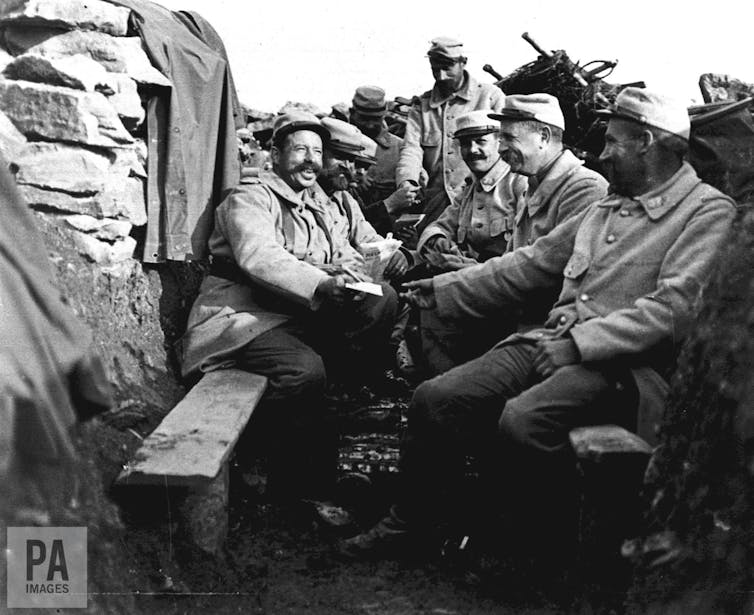
In early 1917, 68 French divisions suffered mutinies. Only the soldiers taking part in what were effectively war machine strikes neither refused to defend their trenches nor abandoned French republic's war aims. The army itself rallied magnificently from this near collapse and played a pivotal role in the Allied victory of 1918. From July to November 1918, French troops captured 139,000 High german prisoners. In the same flow, the American Expeditionary Strength captured 44,142 Germans.
In the interwar years, the French invested heavily in massive defensive fortifications, the Maginot Line, along the Franco-High german frontier. This conclusion has oftentimes been derided equally indicative of a defeatist attitude. Yet French republic had a smaller population than Germany and could non hope to match its field army in size. Fortresses could brand practiced the deficiency. The key point of the Maginot Line was to protect France's industrial heartland from a rapid German offensive and funnel a High german invasion through Belgium. Information technology worked.
The High german Army won the ensuing campaign in May and June 1940, through its audacious "sickle cut" through the Ardennes Forest, which was thought impassable by Allied commanders. This cut off the British, French and Belgian armies to the north and doomed them to defeat.
French strategic planning must comport much of the blame for this catastrophe, yet this was an Centrolineal defeat, not only a French one. The Dutch and Belgians had been reluctant to risk their neutrality and so in that location was little coordination before the Germans struck. And the British clearly assumed that France was to bear the primary brunt of whatsoever land fighting.
The British Expeditionary Force of 1940 had a maximum strength of merely 12 divisions. In 1918, it had numbered 59. Pocket-sized wonder that the Nazi propaganda automobile used to taunt their enemies with claims that the British were "determined to fight to the last Frenchman".
The Dunkirk 'phenomenon'
Although their generals were outclassed in 1940, French troops fought courageously and skilfully. For instance, at the Boxing of Gembloux – May fourteen-15, 1940 – elements of the French First Regular army checked the vaunted German "Blitzkrieg" and won enough time for their comrades and allies to withdraw. Without such tenacious rearguard actions, there would have been no "Miracle of Dunkirk" and the war might have been lost in 1940.
Having crossed the Meuse River, the High german Panzer divisions just had to advance 150 miles to the Channel coast to trap the majority of the Allied forces – 1.8m French soldiers were captured, and 90,000 killed or wounded.
In the opening phase of Operation Barbarossa, the German invasion of the Soviet Union the following year, the Red Army suffered nearly 5m casualties, including 2.5m who surrendered. The Russians besides lost 600,000 foursquare miles of territory. Still, as Charles De Gaulle observed to Stalin, in the aftermath of this colossal defeat, the Soviets still had 5,000 miles of Eurasia into which they could retreat. The French did not lack courage in 1940; they lacked space.
The French military contribution to Allied victory in World War 2 did not end in 1940. In that location were 550,000 Costless French soldiers nether arms in 1944 and they made a major contribution to the liberation of Western Europe. In item, Operation Dragoon – the invasion of southern France in August 1944 – was finer a Franco-American operation, with express British involvement.
Many of the French soldiers involved were recruited in France's African colonies, but this was no different to the British reliance on 2.6m Indian soldiers to support their empire'southward global war attempt. By all accounts, the French units serving in Italia and Western Europe betwixt 1943 and 1945, fought well, in the best traditions of the French Army.
Cheese-eating give up monkeys? It's fourth dimension to call back over again.
jeffersondifuld81.blogspot.com
Source: https://theconversation.com/cheese-eating-surrender-monkeys-its-time-to-give-the-french-army-the-credit-it-deserves-81853

Post a Comment for "The French Are Going to Surrender Again"